
Inner Structure / A Requiem for Daily Operations
Installation /Video

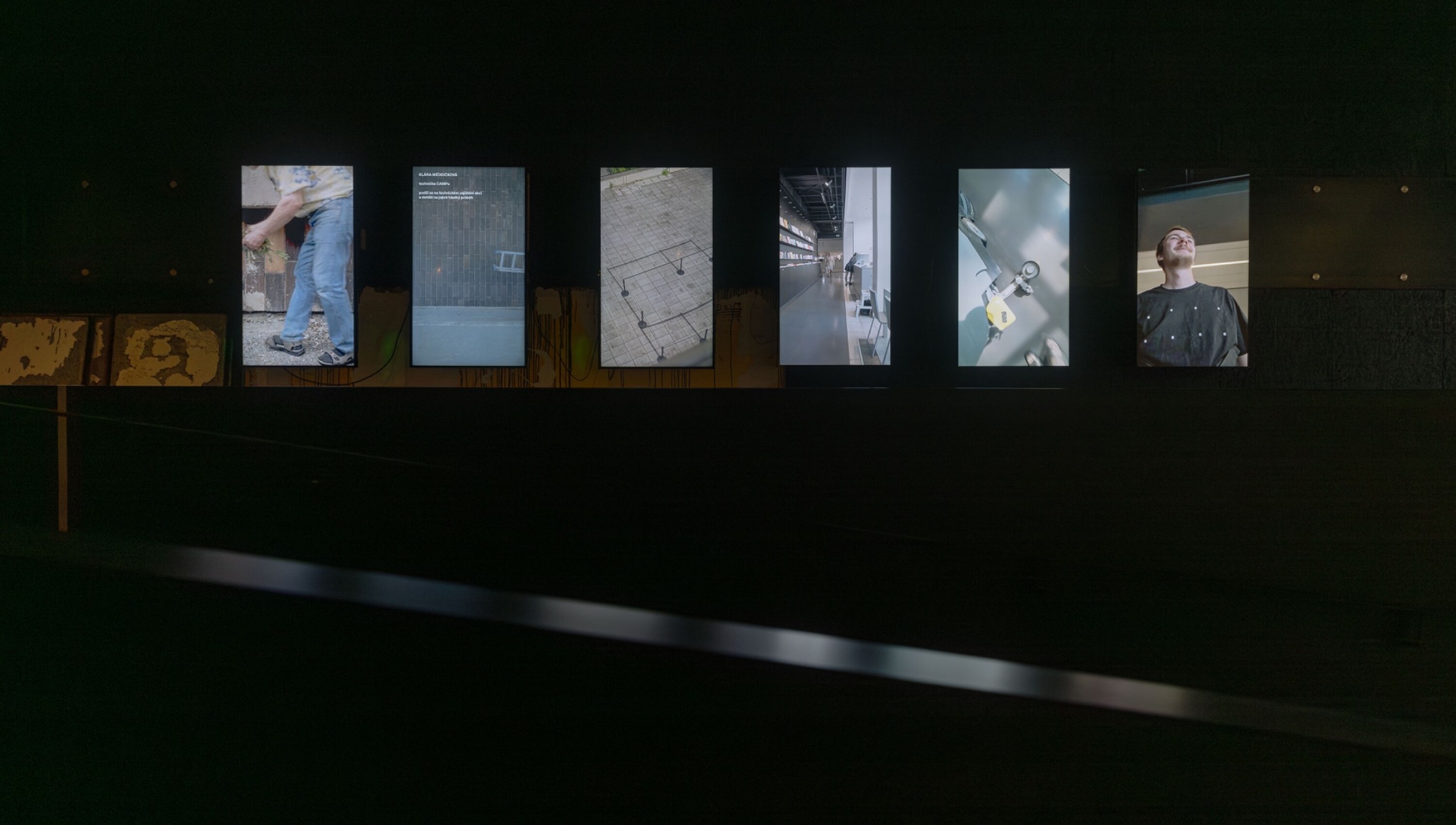


The video installation, consisting of six vertical screens, presents portraits of people who shape the environment of CAMP—the Prague Center for Architecture and Metropolitan Planning—on a daily basis. Through six several-minute videos, attention is directed towards individuals whose work and presence are essential to the functioning of the institution, yet often remain outside the main focus.
The individual portraits observe the everyday activities, gestures, working tools, and rituals associated with each person. Instead of interviews or commentary, the work relies on observation, detail, and the rhythm of repeated actions. An important role is played by the soundtrack, composed of sounds connected to the participants’ different professions and activities. These gradually develop into a shared composition that evokes the building as a living organism.
The project is based on the idea that architecture is formed not only by the building itself, but above all by the people, relationships, care, and everyday labour that sustain it. At the end of the installation, the individual portraits merge into a shared whole and the words “We are the building” are heard, symbolically reminding us that every institution is shaped primarily by those who bring it to life each day.
The work was created as a site-specific intervention within the exhibition concept Stavba povolena (Building Permit Granted), presented prior to the extensive renovation of the Prager Cubes and the temporary closure of CAMP. The participating artists were invited to approach the building as an artwork and respond to the moment of its being vacated and transformed. Within this framework, I chose to focus not on the physical form of the architecture, but on its human and operational infrastructure.
Ms Světlanka has long been responsible for the cleanliness and everyday operation of CAMP. Her work is discreet yet indispensable to the functioning of the entire space.
Mr Smetáček is a regular visitor to CAMP. After each visit, he records his impressions, memories, and personal reflections on the events he has experienced in his diaries.
The Ivy Bandit (Mr Vašek) is an unofficial caretaker and volunteer helper at CAMP. He trims the ivy, cleans the area surrounding the building, and devotes his energy to a place he deeply cares about.
Václav works as a gallery attendant at CAMP. He contributes to the everyday running of the space and helps create the necessary conditions for visitors, exhibitions, and events.
Klára is a technician at CAMP. She manages the technical facilities for exhibitions, screenings, and events, ensuring that everything functions as it should.
Maruška coordinates and prepares CAMP’s programme.
Concept and direction: Lenka Tyrpeklová
Sound design: Oliver Torr
Cinematography: Sláva Pecháček
Sound recording: Jonáš Balcar
Editing: Lenka Tyrpeklová, Matěj Zet
Colour grading: Matěj Zet
Graphic design collaboration: Kryštof Doležal